Unlocking natural instincts to stimulate piglet feed intake
By Sofie Tanghe, researcher Specialties
Weaning is a critical period in a piglet’s life. At weaning, piglets experience abrupt changes in their physical, social and nutritional environment. Weaning stress is associated with a drop in feed intake, resulting in impaired gastro-intestinal barrier function, intestinal inflammation, and often post-weaning diarrhea. It is therefore of utmost importance to stimulate feed intake in newly weaned piglets. To increase feed intake, it is crucial to promote the piglet’s exploration towards the feed and ease the transition from sow milk to dry feed. Earlyfeed specialists have developed Piglet’s Flavorit, an innovative feed intake solution to quickly familiarize the piglet with the feed, attracting it by flavors and tastes it naturally prefers.
Taste and smell are crucial in early feed intake
Research has shown that the sense of taste and smell are extremely well developed in pigs, with pigs having about 3 times more taste buds and functional olfactory receptor genes (responsible for smell) compared to humans. Finding the appropriate feed intake solution is therefore crucial to ensure a good feed intake right from the start. However, what is preferred by humans in terms of taste and smell does not necessarily mean that it is also the ideal flavor profile for piglets. With the development of Piglet’s Flavorit, the R&D team looked from a piglet’s perspective and went back to nature to discover the innate preference of the piglets. Within its search, it was inspired by newborn piglets and how they use their sense of smell to successfully find their way to the sow’s udder.
How Olfactory Cues Guide Newborns
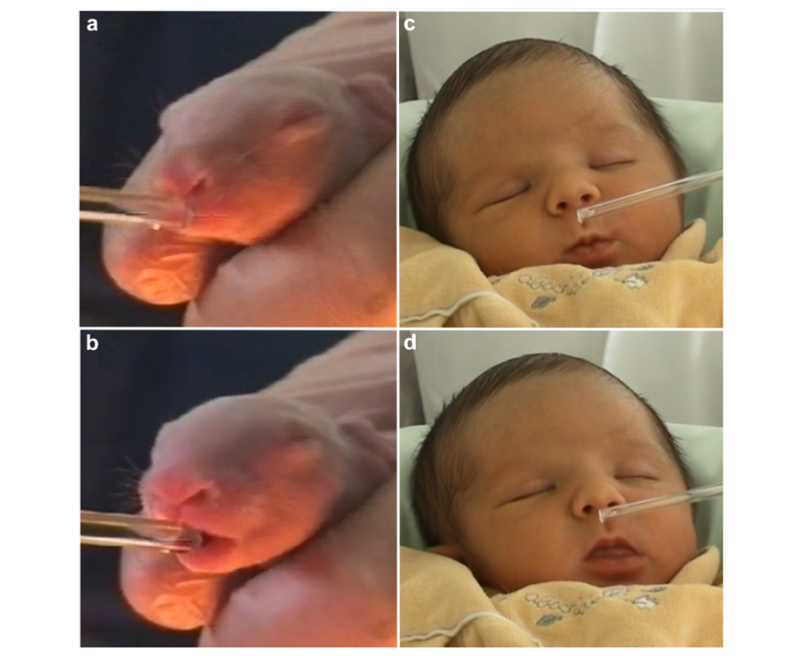
After birth, the newborn piglet receives little assistance from the sow and has to find the nipple to suckle from on its own. Finding and successfully attaching to the sow’s nipple is not only a challenge in piglets, but is experienced by neonates of every mammalian species. A universal solution, found in all female mammals, is the production by the mammary glands of certain olfactory cues that guide the neonate to the nipple. The neonate’s responses to these olfactory cues of the mammary glands are very strong, as shown in Figure 1, with a rabbit pup immediately grasping a glass rod coated with these olfactory cues, and a human infant showing lip pursing and tongue protrusion (Roberts et al., 2026). Studies in human infants also showed increases in crawling behavior and exploratory head movements, and reduced crying (Doucet et al., 2007; Hym et al., 2021).
Mimicking natural instincts in piglet feed
The Earlyfeed team has implemented this knowledge in their piglet feed with the Piglet’s Flavorit concept. This innovative feed intake solution mimics the specific olfactory cues secreted by the sow mammary gland that naturally attract the piglets to the udder. By mimicking these odors, piglets quickly familiarize with the feed, their exploration towards the feed is stimulated, and their early feed intake is increased, leading to a smoother weaning process and improved overall health and performance. To demonstrate the effect, the R&D team conducted several piglet trials and summarized the effect in a meta-analysis.
Quantifying the impact: meta-analysis
To evaluate the effectiveness of Piglet’s Flavorit, a meta-analysis was conducted on five controlled R&D trials performed in Europe between 2021 and 2024. Each trial compared two groups: piglets receiving the new Piglet’s Flavorit feed intake concept versus a positive control (i.e. the former feed intake concept of Earlyfeed). Both groups were fed identical diets, differing only in the feed intake concept.
In total, 1192 piglets were included in the meta-analysis, with weaning ages between 21 and 28 days and different genetics, depending on the specific trial. The trial diets were given post-weaning during the complete nursery period, in two phase feeding. The meta-analysis was conducted with the statistical software environment R, using the metafor package.
The findings were clear: Piglet’s Flavorit significantly improved feed intake compared to the positive control (Table 1). Daily feed intake increased with 15 gram/day in the first phase post-weaning, 33 gram/day in the second phase post-weaning, and 25 gram/day over the total nursery period. This corresponded with a significant increase in total feed intake of 289 gram/pig in the first phase post-weaning, 884 gram/pig in the second phase post-weaning, and 1151 gram/pig more feed intake over the total nursery period (Table 1).
Higher feed intake was accompanied by improved growth performance, with average daily gain increasing with 15 gram/day in the first phase after weaning, 16 gram/day in the second phase after weaning, and 14 gram/day over the total nursery period. No significant effect on feed conversion ratio was observed. In summary, the results of the meta-analysis confirm that Piglet’s Flavorit consistently enhances early feed intake and growth, supporting a smoother transition after weaning and improved overall performance.
| Effect size | P value | |
|---|---|---|
| Daily feed intake (g/day) | ||
| First phase post-weaning | +15 g/d | 0,01 |
| Second phase post-weaning | +33 g/d | 0,01 |
| Total nursery period | +25 g/d | 0,007 |
| Total feed intake (kg/pig) | ||
| First phase post-weaning | +0,289 kg/pig | 0,01 |
| Second phase post-weaning | +0,884 kg/pig | 0,01 |
| Total nursery period | +1,151 kg/pig | 0,007 |
| Average daily gain (g/day) | ||
| First phase post-weaning | +15 g/d | 0,003 |
| Second phase post-weaning | +16 g/d | 0,08 |
| Total nursery period | +14 g/d | 0,03 |
Conclusion
Weaning remains one of the most stressful events in a piglet’s life, often leading to reduced feed intake and compromised health. Earlyfeed specialists have developed Piglet’s Flavorit, an innovative feed intake solution that leverages piglets’ innate sensory preferences. By mimicking natural olfactory cues secreted by the sow mammary gland, Piglet’s Flavorit stimulates early feed exploration and intake. Backed by a meta-analysis, this innovative concept significantly improves piglet feed intake and daily gain post-weaning, proving that nature-inspired solutions can deliver measurable results.
References available upon request.
This contact was suggested based on the location you are browsing from. You can of course also consult our other contacts and locations here.